This article introduces 12 types of excavators and provides selection tips to help you choose the right equipment for efficient work.
As an indispensable piece of equipment in the construction industry, excavators are used in a variety of scenarios: earthmoving, road construction, mining, agricultural land reclamation, and urban demolition. Different scenarios place significantly different demands on the performance and characteristics of the equipment. In this article, we will take a closer look at the 12 main types of excavators, reveal the key features and applications of each, and provide a comprehensive selection guide.

Why are excavators so important in construction?
Excavators are one of the most popular machines on construction sites. Thanks to their flexible working capabilities and powerful characteristics, they are widely used in infrastructure construction, environmental reclamation and resource development. Main areas of use:
Digging trenches — used in the construction of foundations, laying pipelines and cables. They perform precise digging of trenches according to specified parameters.
Demolition of buildings — provide safe and effective demolition of various structures. Compared to traditional methods, they significantly increase productivity and reduce safety risks.
Moving materials — can transport construction debris, non-metallic materials and logs, effectively meeting material handling needs in various operational scenarios.
Channel deepening and maintenance — are used to clean silt and debris from rivers, lakes, and harbors, as well as to modify canals.
Municipal earthworks — non-destructive digging methods are used to lay cables and pipelines without damaging existing infrastructure.
Forestry work — suitable for land clearing and vegetation restoration, contributing to the rehabilitation of the forest environment.

12 common types of excavators and their applications
1. Wheeled excavator
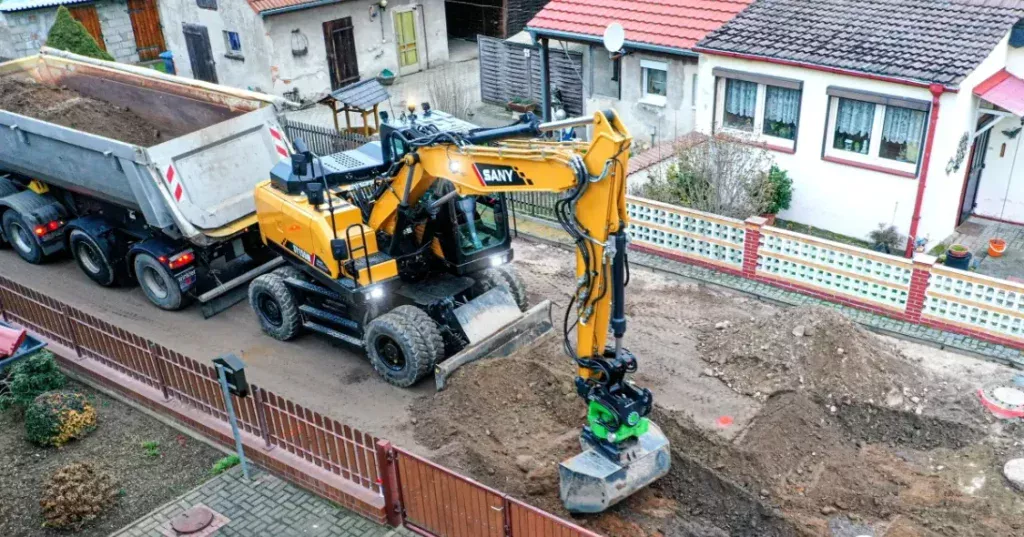
Also known as a "rubber bulldozer," a wheeled excavator is similar in size and appearance to a crawler excavator, but uses wheels instead of tracks.
- Key features: Higher travel speed, comfortable operation on smooth surfaces (concrete, asphalt), improved stability when moving between flat and uneven surfaces thanks to support outriggers.
- Areas of application: Ideal for urban infrastructure - road construction and municipal installation. Especially convenient for operations requiring rapid relocation; can move independently between construction sites without damaging the road surface.
2. Crawler excavator
The crawler excavator is the industry's flagship model. It moves on two large tracks and uses a hydraulic drive mechanism to efficiently lift heavy rocks and soil.
- Key features: The crawler design provides good stability on uneven terrain, the sprocket system allows you to slide safely and overcome slopes. Excellent overall balance, flexibility and stability; powerful hydraulics. However, the speed of movement is lower than in other types.
- Areas of application: Versatile - suitable for digging, demolition, material handling and forestry work. Especially ideal for high-intensity applications such as mining and heavy construction.
3. Excavator with extended boom
The long-arm excavator is equipped with a longer boom and stick designed for deep and long-reach operations. The horizontal radius reaches over 30 meters.
- Key features: The longer boom and stick provide a wider working range and efficient work in hard-to-reach areas. Various attachments can be mounted for cutting, shredding and demolition. The disadvantage is limited flexibility in confined spaces.
- Areas of application: Best suited for demolition projects - demolition of building structures and walls above water; widely used in dredging, underwater excavation and demolition of high-rise buildings. Also suitable for large-scale excavation near rivers and lakes.
4. Mini excavator
A mini excavator, also known as a compact excavator, is a lightweight and compact construction machine that has become widespread among contractors.
- Key features: Small size, light weight, minimal soil damage, flexible movement. Often has a small or zero tail radius, which reduces the risk of collisions with obstacles. Suitable for work in confined spaces and indoors. However, the lifting capacity is limited.
- Areas of application: Suitable for crowded and narrow areas such as parking lots, as well as for indoor construction and scenarios with increased surface protection requirements.

5. Mid-range excavator
A mid-range excavator is the most common type in the construction industry. It is typically equipped with various attachments for a variety of jobs. Typical operating weights range from 8 to 40 tons.
- Key features: Moderate weight - a balance between flexibility and performance. More powerful, with better visibility, able to withstand higher loads. Flexible configuration with a wide range of attachments. However, high loads increase wear on the nodal connections.
- Areas of application: Widely used in construction, infrastructure, earthmoving, quarrying and demolition, suitable for various types of construction sites, especially for earthmoving.
6. Large excavator
Large excavators are designed for heavy work. Giant excavators (mining-grade) are in the super-large category, with a typical operating weight of over 40 tons (up to several hundred tons).
- Key features: Powerful engines capable of withstanding extreme loads and continuous operation. High mass, high durability. The category includes some of the world's largest excavators - super-large hydraulic mining and rotary excavators.
- Areas of application: Suitable for earthmoving, mining, quarrying and demolition of large structures (buildings and bridges). Giant excavators are used mainly in open pit mines.
7. Skid Steer Excavator
This is a specialized machine for working in confined spaces. The boom and bucket are turned away from the operator, allowing attachments to pass directly over the cab.
- Key features: The boom and bucket are turned away from the operator, which allows for agile turns and comfortable operation in confined spaces. Excellent maneuverability, but poor performance on uneven or slippery surfaces.
- Areas of application: Primarily suitable for work in confined spaces: interior demolition, roadworks, debris removal in tight spaces, pool digging, site cleaning, residential construction and garbage removal.
8. Vacuum excavator
A vacuum excavator is essentially a vehicle. Its key component is a suction pipe that uses non-destructive digging techniques. It uses powerful suction combined with a stream of air or water to loosen and remove soil and debris.
- Key features: Equipped with a suction pipe with pointed teeth, it is capable of spraying water to loosen the soil, creating a vacuum to remove soil and debris at speeds of up to 320 km/h. High precision with minimal environmental impact, reduces the likelihood of damage by more than 50%.
- Areas of application: Primarily used in the urban and municipal sectors for locating and servicing underground pipelines, trenchless work, repairing and laying underground pipes/cables/gas pipelines, as well as for environmental cleanup and precision excavation at sensitive archaeological sites.
9. Amphibious excavator
An amphibious excavator is a specialized machine for working in wet environments. Instead of traditional tracks, it uses pontoons, which allow it to float on standing water and move flexibly through swamps, rivers, and shallow water.
- Key features: Uses pontoons instead of traditional tracks, providing buoyancy and flexible movement through standing water.
- Areas of application: Primarily suitable for work in wet and aquatic environments: deepening of waterways, restoration of wetlands, marshes or flood-prone areas, coastal reclamation, flood protection.
10. Hydraulic quarry excavator
This is a large, heavy machine designed for mining and large-scale earthmoving. It is equipped with a bucket at the front connected to a powerful hydraulic boom.
- Key features: Front bucket with powerful hydraulic boom. The hydraulic system provides exceptional lifting and digging power, allowing you to move large volumes of material quickly.
- Areas of application: It is primarily used in open pit mines and large construction projects that require moving large amounts of soil, gravel, or rock.
11. "Spider" excavator (walking)
Also known as a walking excavator, it is a uniquely designed specialized machine. Without tracks and wheels, with adjustable outriggers that allow it to "walk" over uneven and steep terrain.
- Key features: Without tracks or wheels, it is equipped with adjustable outriggers for flexible movement on uneven and steep terrain. The outriggers are independently adjustable, keeping the cab level even when working at extreme angles.
- Areas of application: It is primarily suitable for difficult and special environments: forestry, strengthening river banks, construction in mountainous areas. It is often used for emergency rescue operations after natural disasters - landslides and floods.
12. Backhoe Loader
A backhoe loader combines a front-end loader and a standard excavator. There is a bucket in the front and a small digging arm (backhoe) in the back.
- Key features: Combines the advantages of a front-end loader and a standard excavator. The rear boom can be equipped with the same attachments as a standard excavator. The front bucket and rear boom are interchangeable, allowing you to effectively perform multiple tasks on the site.
- Areas of application: Widely used on small construction sites and farms: digging trenches, earthmoving, moving materials, building small foundations, installing drainage systems and light demolition. Also suitable for various auxiliary works in agriculture and landscaping.

How to choose the right type of excavator for your project?
Determine the type of work — clarify the scale of the excavation, the duration of the project, and the specific tasks to avoid equipment mismatches and delays.
Determine the size of the excavator — from mini to extra-large, depending on the scale of the project. Use specialized platforms to compare models.
Consider the terrain — tracked excavators are suitable for muddy and uneven terrain, wheeled excavators are flexible and efficient on city roads.
Choose the right engine — give preference to diesel engines with the optimal combination of power, torque and environmental standards.
Select compatible attachments — select buckets and other devices according to the operational needs and lifting capacity of the machine.
Weigh the benefits of buying or renting — renting is suitable for short-term and special needs; purchasing is for long-term and continuous operation.
Conclusion
So, there are many types of excavators, each with its own focus. 12 different types are suitable for a variety of working conditions - from urban infrastructure to mining operations, from confined inland spaces to wetlands. By understanding the key features and applications of each type, combined with a comprehensive selection guide, you can accurately match the equipment to the requirements of the project, significantly reducing construction costs and increasing work efficiency.
Frequently Asked Questions (FAQ)
What are the three types of earthworks? Earthworks are divided into three types: topsoil removal, earthworks (removal of ordinary soil beneath the topsoil), and rock works (removal of rock using special equipment).
Which excavator is used most often? The most popular is the 20-ton class excavator (approximately 18-22 tons), which is considered the industry standard for general construction work. It provides an excellent balance between digging power, fuel efficiency, and ease of transportation.
What are the 5 P's of safe digging? The five key elements of safe digging (5 Ps): Planning, Preparation, Pit, Protection, and Follow-up — each subsequent step is performed only after the previous one is completed.