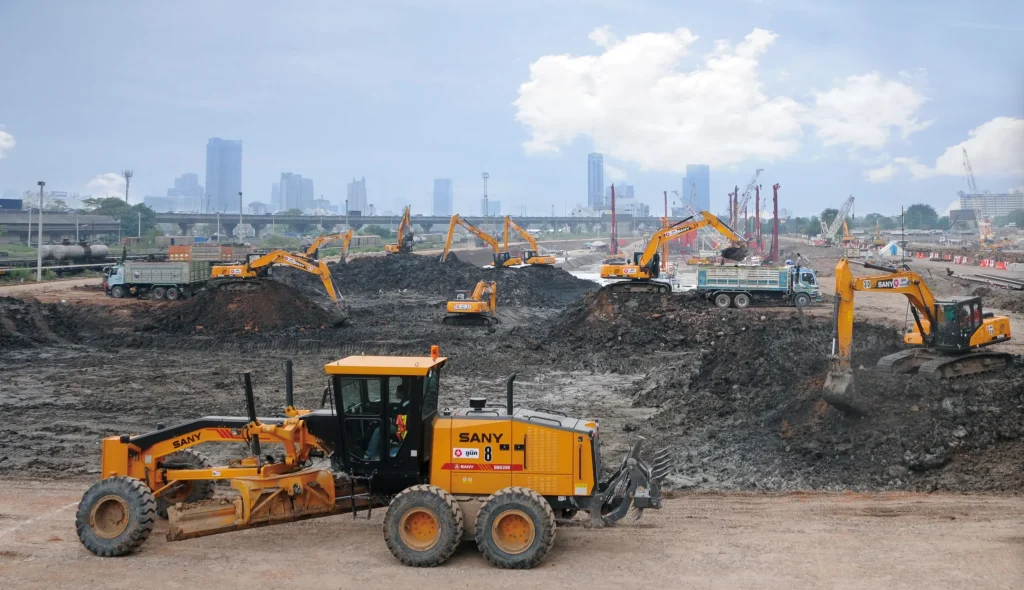
This article introduces the types of graders, their main characteristics, and selection recommendations for construction professionals.
In earthmoving, road construction and site preparation, motor graders are indispensable basic equipment. Different types of motor graders, each designed for specific functions, can meet operational needs in different scenarios. Understanding the types of motor graders, their basic knowledge, design, working principles and selection methods is the key to effective use of this equipment and improving work productivity.
What is a motor grader?
A motor grader, also known as a road grader or motorized grader, is an earthmoving machine used to level surfaces and form soil or asphalt. It is widely used in various scenarios: it can give a surface a flat appearance or slope at a given angle, remove irregularities, distribute materials, maintain dirt roads, and also assist in the construction of ramps and drainage ditches to ensure that the final project meets design requirements.
What are the design features of a motor grader?
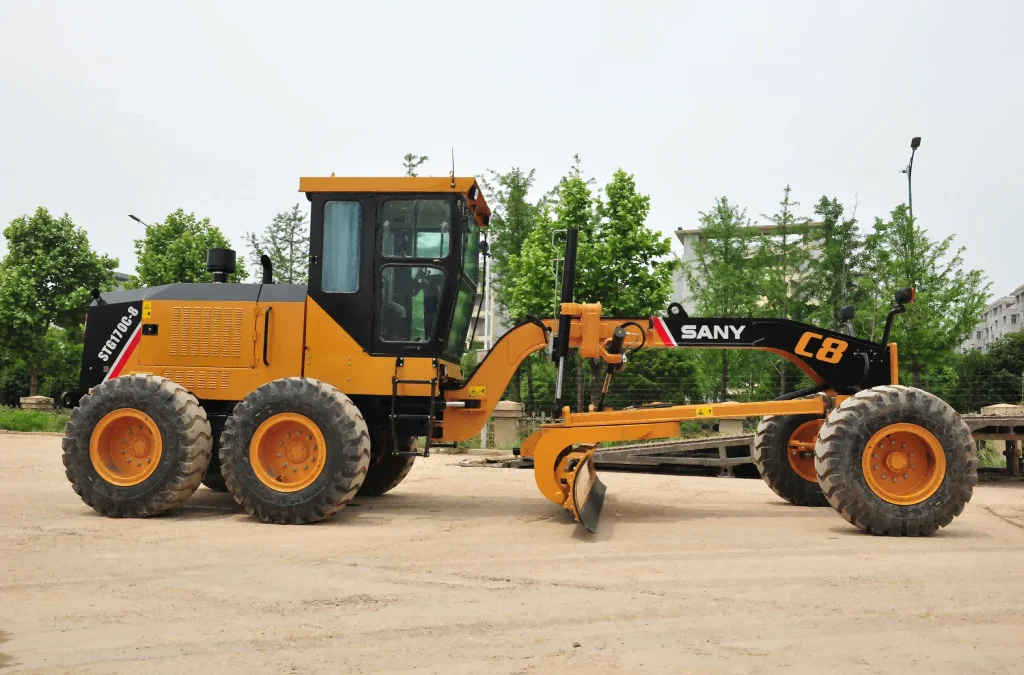
Graders have a unique elongated body and three-axle design. The main components include a blade with adjustable angle and height, a frame, an engine and a control system. Some models are also equipped with attachments - discs and rippers. A typical grader has three axles: the engine and cab are located above the rear axle at one end of the machine, a third axle is at the front, and the blade is located between them.
What is the working principle of a motor grader?
The motor grader works through the coordinated operation of the main components and flexible blade control. The first axle drives the steering wheel at the front, the second axle carries the blade for leveling the ground or cutting slopes, and the third axle is equipped with tandem wheels under the cab and engine, which ensures flexible movement. From the cab, the operator has a clear view of the working area and can precisely adjust the height, tilt angle and rotation angle of the blade according to different operational needs.
What are the types of motor graders?
Motor graders are divided into different types according to two main parameters: frame design and machine size. Each type of grader has clearly defined design characteristics, control methods and corresponding areas of application.
Classification by frame design
1. Rigid frame grader
- Design features: It uses a rigid, fixed rectangular frame with a single axle, a stable overall structure with low mechanical wear. It is usually equipped with six wheels: four at the rear under the cab, two at the front; the blade is mounted behind the front wheels.
- Main advantages: Simple design, low maintenance cost, high stability. Allows for accurate cutting angle and uniform leveling effect. Suitable for operations where precision and strength are more important than flexibility.
- Areas of application: Widely used in daily leveling operations: farms, construction sites, airport runways, highways, industrial sites. Suitable for straight-line or large-scale leveling operations.
2. Articulated grader
- Design features: Connects the front and rear frames via a pivot pin, equipped with a central hinge, allowing independent movement of the front and rear parts. Usually has two axes, allowing the front frame and blade to be moved and positioned relative to the rear frame.
- Main advantages: Small turning radius, high maneuverability, efficient work in narrow spaces, adaptation to difficult terrain. It is one of the most popular types in the construction industry.
- Areas of application: Suitable for large-scale projects requiring flexible maneuverability and precise turns: snow removal, construction of curved road sections, urban development, parking lot construction, maintenance of curved roads. Adapts to uneven or curved terrain.
Classification by size
1. Compact grader
- Characteristics: Typically 80–150 hp, equipped with a small blade, compact body, easy to operate.
- Main advantages: Extremely high maneuverability, especially suitable for working in narrow spaces. Low complexity of control, does not require special conditions for the working area.
- Areas of application: It is mainly used in small construction projects, landscaping, lawn mowing, small area landscaping, and daily maintenance of dirt roads.
2. Medium-sized grader
- Characteristics: 150–300 hp, compared to the small one, it has a longer blade and larger wheels, moderate power and higher productivity.
- Main advantages: Balance between power and flexibility, covers a larger working area, adapts to various medium and large construction scenarios, high versatility.
- Areas of application: Mainly used in large public projects and construction scenarios: highways, regular roads, large construction sites. Can also be used for leveling hard surfaces.
3. Large-sized grader (heavy grader)
- Characteristics: Over 300 hp, large size; some models weigh over 70 tons, blade widths can reach 7.3 meters. Capable of operating wider blades and various hydraulic attachments.
- Main advantages: Powerful engine, high performance, ability to handle large-scale and high-intensity leveling operations. Outstanding lifting capacity and working range.
- Areas of application: Primarily used in large-scale operations: mining, large residential and commercial construction, large-scale land development. Limitations include more difficult operation in narrow spaces and relatively high fuel consumption.
How to choose a motor grader?
Choosing the right motor grader requires consideration of several factors and precise selection according to the specific construction scenario.
Identify the main tasks and areas of application
- Large-scale projects (large-scale leveling and earthmoving: large construction sites, mining, large-scale land development) - prefer heavy graders with a powerful engine and a large blade.
- Small and medium projects (road maintenance, small site preparation, landscape design) — choose compact and maneuverable small and medium graders.
Pay attention to the key specifications
- Engine power: Directly determines the performance of the machine and must accurately match the type of work and operating conditions.
- Hydraulic system: Affects the smoothness and precision of blade control. Advanced hydraulic systems simplify control and increase efficiency.
- Blade parameters: Materials include steel, carbon steel or tungsten carbide; shapes include smooth, serrated, etc. Note: Too large a blade can increase the load on the transmission and frame of small graders.
- Drive system: Tandem rear-wheel drive is suitable for standard operating conditions. For difficult terrain (dirt, snow, sand), all-wheel drive is preferred.
- Tires and tread: Radial tires provide better cushioning, bias tires provide more direct feedback to the road. Smooth tread is ideal for precise alignment, deep for high-traction scenarios.
Pay attention to ease of use and technical configurations
- Cabin comfort: Ergonomic design with excellent visibility and easy controls for a balance between productivity and safety.
- Advanced technologies: Choose models with automatic articulated steering, automatic speed control, diagnostic data collection, and pre-set blade control.
Consider economic costs and service support
- Cost accounting: Balance the initial purchase cost and long-term operating costs, including fuel consumption, maintenance, and spare parts costs.
- Service and brand: Choose reputable manufacturers with a developed dealer network for convenient and reliable service and spare parts supply.
Frequently Asked Questions (FAQ)
How much does a 12M grader cost? There is no single answer. Grader prices depend on many factors: brand, size and power, technology and features, as well as market supply and demand. A grader with advanced features — GPS grade control, automatic blade control, telematics — is usually more expensive. Prices may be lower in the off-season, and insufficient market supply increases the cost.
Can graders be used for snow removal? Yes, graders are extremely effective at clearing snow and are often used to clear roads during heavy snowfalls. They can be equipped with standard blades, snow wings or V-plows. They are excellent at crushing and compacting snow and effectively clear long distances. They are one of the most powerful tools in snow removal operations.
What are the typical problems of road graders? Typical problems with graders include hydraulic system leaks and failures, engine overheating due to poor maintenance, and transmission problems such as gear failures. Other common problems include uneven blade wear leading to poor alignment, electrical system failures, and slow rotation due to insufficient lubrication of the joints. Regular inspection and maintenance are recommended to avoid these problems.